
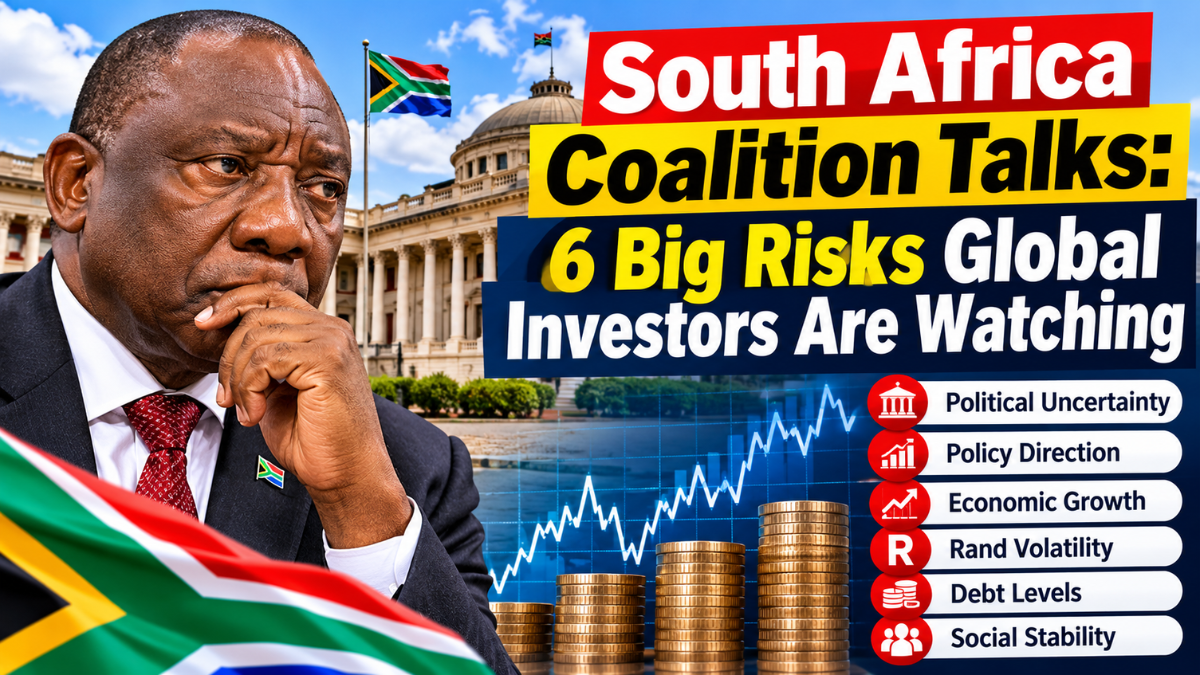
Why Investors Are Watching South Africa’s Coalition Negotiations
South Africa’s coalition negotiations have become an important focus for investors following the country’s November 2026 municipal elections, which significantly changed the political landscape. With the African National Congress (ANC) losing support and several municipalities facing coalition governments, investors are closely monitoring whether political parties can reach agreements that promote stability, economic growth and consistent government policies.
The outcome of these negotiations could have consequences beyond municipal politics. Businesses, financial institutions and international investors want reassurance that South Africa will maintain a predictable economic environment while addressing long-standing challenges such as unemployment, poor service delivery, infrastructure shortages and slow economic growth.
November 2026 Elections Increase Political Uncertainty
The November 4 municipal elections delivered a significant setback for the ANC, which received approximately 30.76% of the vote, compared with 24.64% for the Democratic Alliance (DA).
The results reflected growing political competition and increasing dissatisfaction among voters over municipal performance and basic service delivery.
Several major municipalities, including Johannesburg, Tshwane and eThekwini, are expected to require coalition agreements because no political party secured an outright majority.
Political parties have limited time to negotiate arrangements that will determine who governs these municipalities.
According to reports, the negotiations will be particularly important in Gauteng’s major economic centres, where political decisions can influence business confidence, infrastructure investment and employment opportunities.
Why Investors Are Concerned About Coalition Stability
Investors generally prefer countries with predictable policies, stable institutions and governments capable of implementing long-term economic plans.
When political parties struggle to cooperate, important decisions can be delayed. This can create uncertainty for companies considering expanding their operations, investing in infrastructure or establishing new businesses.
South Africa’s Government of National Unity (GNU), established after the 2024 national elections, initially helped improve investor confidence by bringing different political parties into government.
However, disagreements between coalition partners have raised questions about how sustainable the arrangement will be.
Following the latest municipal election results, concerns have also emerged about possible changes to the national coalition.
Reports indicate that some ANC members are considering whether the party should reconsider its relationship with the DA.
Any major changes to the GNU could influence investor perceptions of South Africa’s economic direction.
Economic Reforms Remain a Major Priority
Investors are also watching whether South Africa will continue implementing economic reforms aimed at improving electricity supply, strengthening transport infrastructure and making it easier for businesses to operate.
Reforms involving Eskom, Transnet and other state-owned enterprises remain important for the country’s economic recovery.
Businesses need reliable electricity, efficient ports, functioning railway networks and predictable regulations to operate successfully.
Coalition disagreements that delay these reforms could weaken confidence and discourage potential investment.
On the other hand, political cooperation could help accelerate infrastructure improvements, support business expansion and create opportunities for employment.
Municipal Governance Could Influence Business Growth
The negotiations are particularly important because municipalities are responsible for services that directly affect businesses and communities.
Reliable water supply, electricity distribution, roads, sanitation and waste management are essential for economic activity.
Poor municipal management can increase operating costs, disrupt production and discourage businesses from investing in affected areas.
Investors therefore want incoming coalition governments to demonstrate that they can manage municipal finances, maintain infrastructure and improve service delivery.
Economists have also highlighted the importance of cooperation between government and the private sector in addressing infrastructure challenges and unlocking local economic opportunities.
What Could Happen to the Rand and Investor Confidence?
Political uncertainty can influence how investors assess South African financial assets, including government bonds and the rand.
Investors may become cautious when they believe political disagreements could weaken economic reforms or create uncertainty around government spending and financial management.
Recent market commentary has highlighted coalition negotiations as one of the factors investors are monitoring alongside international oil prices and global financial developments.
However, political uncertainty does not automatically mean that the rand will weaken or that investors will withdraw their money. Currency movements are influenced by several domestic and international factors.
What Happens Next?
South Africa’s political parties now face the challenge of negotiating coalition agreements that can provide stable municipal administrations.
The ANC’s national leadership is also expected to discuss the party’s electoral performance and its approach to future coalition arrangements.
Investors will be looking for clear indications that political leaders are prepared to work together, protect economic reforms and prioritise effective governance.
Ultimately, the success of these negotiations will be measured not only by which parties secure mayoral positions but also by whether the resulting governments can improve service delivery, attract investment and create employment opportunities.
For South Africa, stable coalition arrangements could strengthen confidence in the country’s economic future. However, prolonged political disagreements and policy uncertainty could make businesses and investors more cautious.