
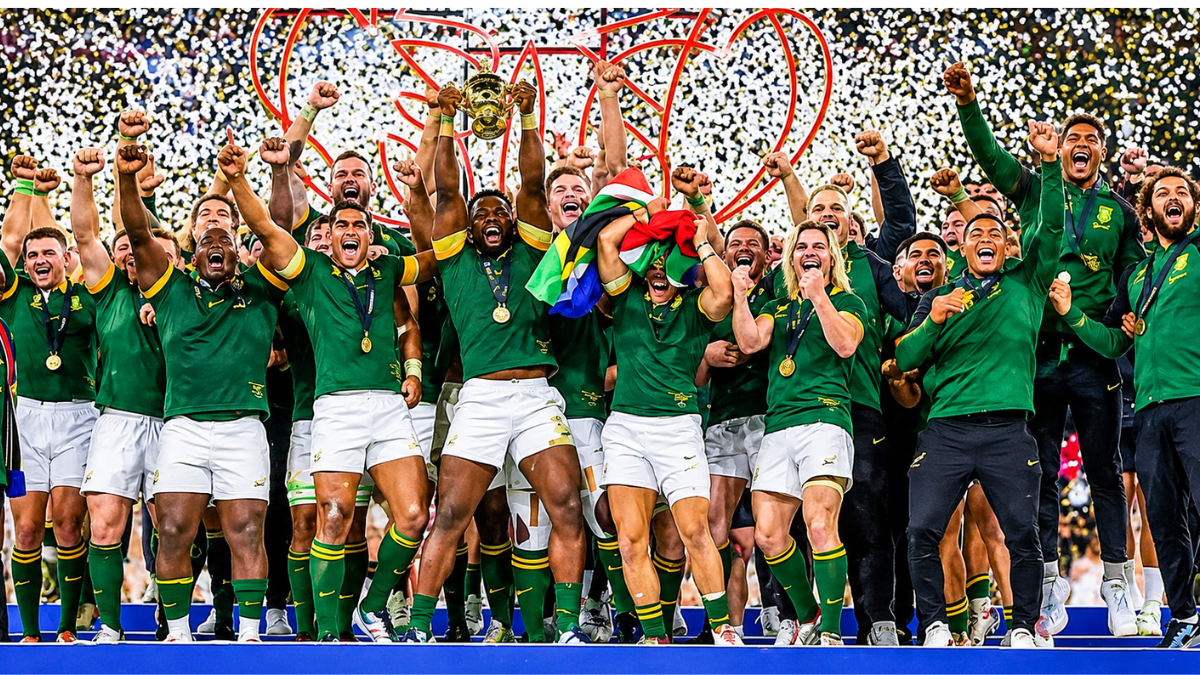

The Springboks may have established themselves as the leading force in international rugby, but the unusual structure of the inaugural Nations Championship could give New Zealand a significant advantage in the race to become champions.
South Africa and the All Blacks both enjoyed impressive starts to the competition in July, winning all three of their opening matches. However, the tournament’s conference system means that only one of the two southern hemisphere giants can qualify for the grand final against the leading northern hemisphere team.
The situation has raised questions about whether the competition will ultimately reward the strongest team or simply the side that benefits most from the fixture schedule.
How the Nations Championship format works
The 2026 Nations Championship brings together 12 international teams, divided into northern and southern hemisphere groups.
South Africa, New Zealand, Australia, Argentina, Fiji and Japan represent the southern hemisphere, while England, France, Ireland, Scotland, Wales and Italy compete in the northern group.
Each team plays six matches, with three fixtures taking place in July and another three in November.
At the end of the league phase, teams are ranked within their respective hemispheres. The two top-ranked nations qualify for the main final, while the remaining teams face opponents who finish in corresponding positions.
The first-place teams from each hemisphere will meet on 29 November at Allianz Stadium in Twickenham to determine the inaugural champion.
This arrangement is different from a traditional league competition because a team can win all six matches but still miss the main final if another country finishes above it in the same hemisphere.
Why New Zealand could benefit
The All Blacks could have a more favourable November schedule than the Springboks.
New Zealand’s remaining league fixtures include Scotland, Wales and England. South Africa, meanwhile, must travel to Italy before facing France and Ireland in two demanding encounters.
The Springboks are scheduled to play Italy on 7 November, France on 13 November and Ireland on 21 November.
Although New Zealand still face difficult opponents, the fixture arrangement could create opportunities to improve their points difference, particularly against Wales.
Points difference could become decisive if South Africa and New Zealand finish level on competition points. The All Blacks entered the November fixtures with a points difference of 51, compared with South Africa’s 81 after the opening three rounds.
That means the Springboks currently have an advantage, but the remaining matches could change the standings considerably. Daily Maverick
Springboks face a difficult European challenge
Rassie Erasmus and his coaching team must balance the ambition of winning the tournament with the need to manage player fitness.
South Africa have already demonstrated their squad depth during the international season, using numerous players and testing combinations ahead of the 2027 Rugby World Cup.
However, consecutive matches against France and Ireland will demand considerable physical and tactical preparation.
The Springboks will need to manage injuries, fatigue and squad rotation carefully if they want to remain competitive throughout the November campaign.
Their recent success against New Zealand has also increased expectations among supporters, who will be hoping the team can translate its strong performances into another major international trophy.
Could the competition’s format be changed?
The Nations Championship was introduced to give international rugby a more structured competition between the northern and southern hemispheres.
However, critics argue that the format creates an unfair situation because the two strongest teams in one hemisphere cannot both contest the main final.
The possibility of a team winning every league match but missing out on the championship decider has become one of the biggest talking points surrounding the tournament.
For supporters, the debate is straightforward: should the final feature the two best-performing teams overall, or should the competition prioritise a northern-versus-southern hemisphere showdown?
The answer could influence how the tournament develops in future editions.
For now, the Springboks and All Blacks must concentrate on their remaining fixtures. South Africa has the advantage in points difference, but New Zealand has an opportunity to challenge that position.
The race for the inaugural Nations Championship title is far from settled
Live updates: Springboks and All Blacks battle for Nations Championship position
7 November 2026 – Springboks prepare for Italy test
South Africa are scheduled to face Italy in Turin as the November stage of the Nations Championship begins. The match is an important opportunity for the Springboks to protect their position at the top of the southern hemisphere standings.
7 November 2026 – All Blacks face Scotland
New Zealand take on Scotland at Murrayfield. The All Blacks will be looking to maintain their unbeaten record and collect valuable competition points.
6 November 2026 – November fixtures get under way
Ireland face Argentina in Dublin in the opening fixture of the November programme.
1 November 2026 – Concerns raised about tournament structure
Analysis published by Daily Maverick highlighted how the conference system could prevent one of the strongest teams from reaching the final, even if it wins all six league matches.
29 November 2026 – Nations Championship final scheduled
The top-ranked teams from the northern and southern hemispheres are scheduled to meet at Allianz Stadium in Twickenham to decide the inaugural champion.