
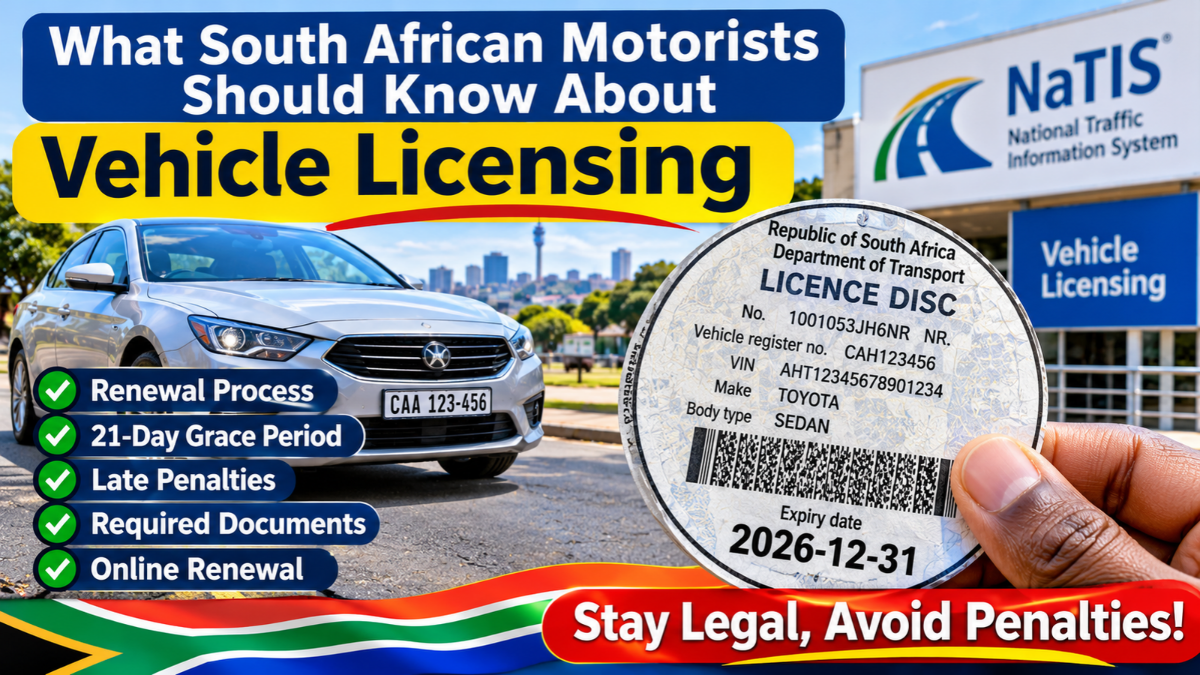
What South African Motorists Should Know About Vehicle Licensing
Learn about vehicle licensing in South Africa, including annual renewals, the 21-day grace period, late penalties, required documents and online renewal.
Vehicle licensing is an important part of road administration in South Africa. However, motorists sometimes forget renewal dates, misunderstand the grace period or are unsure which documents they need when applying for a new licence disc.
Understanding the process can help vehicle owners avoid delays and manage their responsibilities more effectively.
1. Vehicle Licence Discs Must Be Renewed Every Year
In South Africa, most motor vehicle licence discs must be renewed annually. The expiry date is printed on the disc displayed on your vehicle.
It is the registered owner’s responsibility to ensure that the licence remains valid. Motorists should not rely entirely on receiving a renewal reminder because notices may not always reach the correct address or arrive on time.
A useful practice is to check the expiry date several weeks in advance and arrange payment before the deadline.
Certain vehicle categories have different licensing arrangements. For example, buses must generally be licensed every six months because their roadworthiness certification is valid for six months.
2. Understanding the 21-Day Grace Period
One important detail motorists should understand is the 21-day grace period that applies after a vehicle licence expires.
According to South African government guidance, motorists have 21 days from the expiry date to renew an expired motor vehicle licence without incurring late-renewal penalties and arrears.
However, this should not be treated as an extension of the licence’s validity for driving purposes. Motorists should avoid using a vehicle with an expired licence disc on public roads and should arrange renewal as soon as possible.
Waiting until the final days of the grace period can also create unnecessary pressure, particularly when licensing offices are busy.
3. What Happens If You Renew Your Licence Late?
Failing to renew a vehicle licence within the applicable period can result in additional costs.
Once the grace period has passed, the registered owner becomes liable for late licensing penalties and outstanding licence fees. The amount payable depends on the vehicle and the period for which the licence has remained unpaid.
This can become expensive when motorists allow several months or years to pass without renewing their licence discs.
Vehicle owners should therefore check their outstanding licensing amounts before making payment. If a vehicle has been unlicensed for an extended period, they should contact the relevant registering authority to establish what steps are required.
4. Documents Needed to Renew a Vehicle Licence
Motorists renewing a vehicle licence at a registering authority should prepare the required documents before visiting the office.
For a vehicle registered in an individual’s name, the usual requirements include:
- A valid South African identity document.
- Proof of residential address.
- The motor vehicle licence renewal notice, known as the MVL2.
- Payment of the applicable licensing fee.
If the renewal notice has not been received, the motorist may need to complete an Application for Licensing of Motor Vehicle form, known as the ALV.
Additional documentation may be required when the vehicle is registered in a company’s or organisation’s name. This can include the organisation’s business certificate, the proxy’s identification document and a letter of proxy.
Requirements may differ between registering authorities, so motorists should confirm the latest document requirements before travelling to a licensing office.
5. Can You Renew Your Vehicle Licence Online?
Yes. South African motorists can use the National Traffic Information System (NaTIS) online platform to renew eligible vehicle licence discs.
The online process allows registered users to access vehicle renewal information and make payments without necessarily visiting a licensing office.
The general process involves:
- Visiting the NaTIS online platform.
- Registering or logging into your profile.
- Selecting the vehicle renewal option.
- Choosing the vehicle that requires renewal.
- Following the payment instructions.
- Arranging delivery of the new licence disc where the service provides this option.
Motorists should ensure that their personal and vehicle details are correct before completing the transaction.
Online renewal can be particularly useful for people who want to avoid long queues or cannot easily visit a licensing office during working hours.
6. What Should You Do When Buying a Used Vehicle?
Buying a second-hand vehicle involves more than checking its mechanical condition and negotiating the purchase price. Buyers should also confirm that the vehicle’s registration and licensing records are in order.
When ownership changes, the vehicle must be registered in the new owner’s name within 21 days.
The buyer should ensure that the seller has completed the required notification of change of ownership process. The relevant registration documents, proof of purchase and other required paperwork must also be submitted to the registering authority.
Buyers should check whether the vehicle has outstanding licensing fees and whether a roadworthy certificate is required.
Taking these steps can help prevent administrative complications after purchasing a vehicle.
7. What Happens If a Vehicle Is Not Licensed for Several Years?
Motorists who leave their vehicles unlicensed for long periods may face more complicated registration issues.
According to the South African government, a vehicle’s registration becomes null and void if its licence disc has not been renewed for more than four years.
Other circumstances can also result in registration becoming invalid, including a change of ownership or the issuing of a deregistration certificate.
Owners of vehicles that have been unlicensed for an extended period should contact their relevant registering authority before attempting to use the vehicle on public roads.
8. How Motorists Can Avoid Licensing Problems
Keeping a vehicle licence up to date does not have to be complicated. A few simple habits can help motorists avoid unnecessary expenses and administrative delays.
Consider the following practices:
- Check expiry dates regularly: Look at the date printed on your licence disc and record it on your calendar.
- Renew early: Do not wait until the final day to arrange payment.
- Update your contact details: Ensure your address and other relevant information are correct on the NaTIS system.
- Keep documents accessible: Store your registration certificate and renewal information safely.
- Use official payment channels: Be cautious of suspicious messages requesting personal or banking information.
- Check outstanding amounts: Confirm whether any arrears or penalties are payable before completing your renewal.
These measures can make the licensing process easier and help motorists remain compliant.
9. Vehicle Licence Disc Versus Driving Licence Card
It is important not to confuse a vehicle licence disc with a driving licence card.
A vehicle licence disc relates to the registration and licensing of the motor vehicle. It must be renewed by the registered owner according to the applicable licensing period.
A driving licence card, on the other hand, confirms that an individual is authorised to drive particular categories of vehicles.
The two documents have different renewal processes and requirements. Renewing your vehicle licence does not renew your driving licence card, and having a valid driving licence does not mean your vehicle is properly licensed.
Conclusion
Vehicle licensing is an important responsibility for every South African motorist. Renewing a licence disc on time helps avoid late penalties, outstanding fees and possible complications when using or selling a vehicle.
Motorists should understand the annual renewal requirement, know how the 21-day grace period works and prepare the correct documents before applying.
With online renewal options available through NaTIS, keeping a vehicle licensed can be more convenient. The most important step is to remain aware of expiry dates and take action before a licence becomes overdue.