
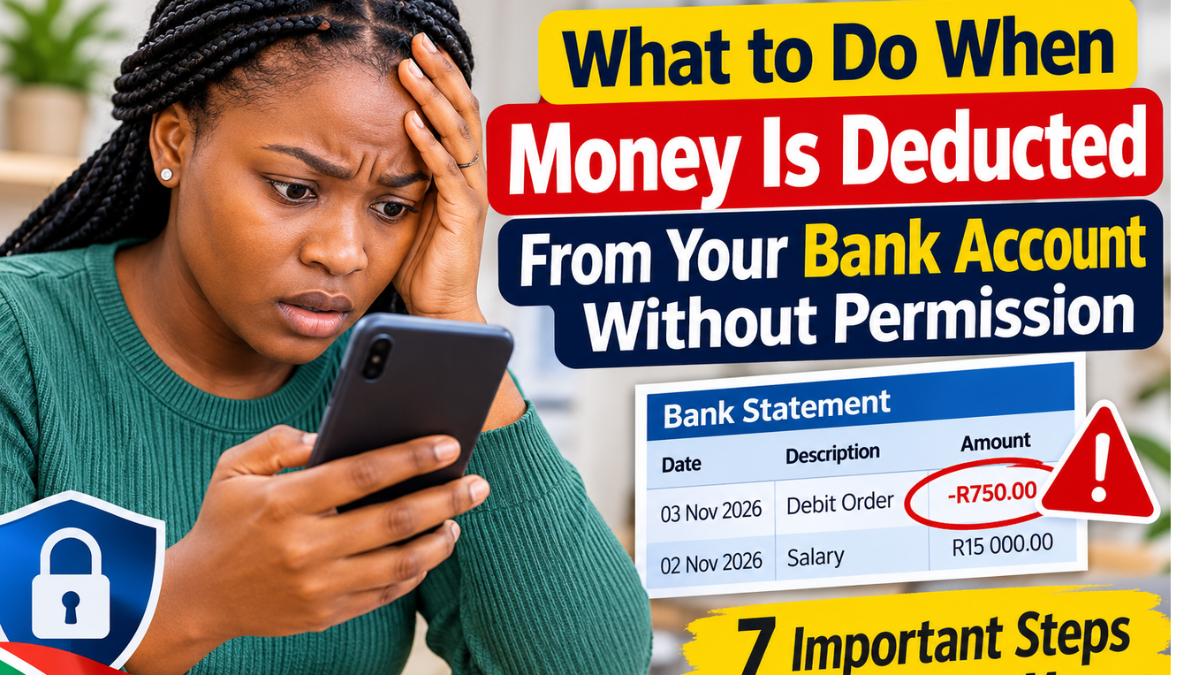
What to Do When Money Is Deducted From Your Bank Account Without Permission
Discovering that money has disappeared from your bank account without your permission can be stressful, especially when you depend on every rand to cover groceries, transport, electricity and other monthly expenses.
Unauthorised bank deductions are a concern for many South Africans. Sometimes the money is taken through an unfamiliar debit order, an unexpected subscription payment or a transaction linked to stolen banking details.
The good news is that there are steps you can take to challenge suspicious transactions, protect your remaining money and potentially recover funds that were taken without your authorisation.
Here is what you should do if you notice an unfamiliar deduction from your bank account.
1. Check Your Bank Statement Immediately
The first step is to establish exactly where your money went.
Log into your banking application or internet banking account and examine your recent transactions. Look for unfamiliar company names, unexpected debit orders, repeated deductions or amounts that differ from payments you normally make.
Some companies use abbreviated names when processing debit orders, which can make legitimate transactions difficult to recognise.
If you do not recognise a transaction, contact your bank and request more information about the business or organisation responsible for the deduction.
Do not ignore even small amounts. Unauthorised deductions can happen repeatedly, potentially costing you hundreds of rand over several months.
2. Contact Your Bank and Report the Transaction
Once you identify a suspicious deduction, contact your bank as soon as possible.
Explain that money was deducted from your account without your permission and ask the bank to investigate the transaction.
Depending on the type of payment, your bank may allow you to dispute the debit order through its mobile application, internet banking platform or customer service department.
Provide the transaction date, amount and any available reference details.
If you suspect that someone has accessed your banking account, report possible fraud immediately. Ask your bank to secure your account, block compromised cards or digital banking access where necessary, and investigate suspicious transactions.
3. Dispute the Unauthorised Debit Order
If the deduction was made through a debit order you never approved, you may be able to dispute it.
South African consumers have the right to query debit orders they believe were incorrectly processed against their accounts.
The Payments Association of South Africa (PASA) advises consumers to investigate unfamiliar debit orders and approach the relevant service provider to resolve the matter.
From 13 April 2026, updated industry rules reduced the dispute period for applicable debit order collections to 60 days. However, the rules depend on the payment type, and valid authorised DebiCheck transactions have different protections.
Contact your bank immediately to establish whether the transaction qualifies for a reversal.
4. Contact the Company Responsible for the Deduction
If you can identify the business that deducted the money, contact its customer service department.
Ask the company to explain why money was collected and request a copy of the agreement or authorisation that supposedly allowed the deduction.
If you never signed up for the service, clearly state that you did not authorise the payment.
Keep records of emails, reference numbers and conversations. These documents may become important if you need to escalate your complaint.
5. Stop Future Unauthorised Deductions
Getting your money back is important, but preventing further deductions is equally necessary.
Ask your bank about stopping or suspending the suspicious debit order. You should also contact the service provider to cancel any agreement if one exists.
Remember that stopping a debit order through your bank does not automatically cancel a contract with a service provider.
If your banking details have been compromised, discuss changing your account details or taking additional security measures with your bank.
6. Escalate the Complaint if Your Bank Does Not Help
If your bank fails to resolve your complaint, you do not have to give up.
First, submit a formal complaint through the bank’s official complaints department and request a written response.
If the matter remains unresolved, you can approach the Ombudsman for Banking Services (OBS), which provides assistance with eligible complaints involving banks.
The ombudsman can investigate disputes and help consumers seek a fair resolution.
7. Protect Your Banking Details in Future
Preventing unauthorised deductions starts with good banking habits.
Never share your banking PIN, password or one-time passwords with anyone. Avoid clicking suspicious links claiming to come from your bank, and be careful when entering your banking details on unfamiliar websites.
Check your bank statements regularly and activate transaction notifications where available.
If you receive a notification about a debit order or payment you do not recognise, investigate it immediately.
Conclusion
Having money deducted from your bank account without permission can create serious financial difficulties, particularly for households already struggling with rising living costs.
However, you have options. Check your statements, report suspicious transactions, dispute unauthorised debit orders and keep evidence of every complaint.
Most importantly, act quickly. The sooner you report an unauthorised deduction, the better your chances of addressing the problem before more money disappears from your account.