
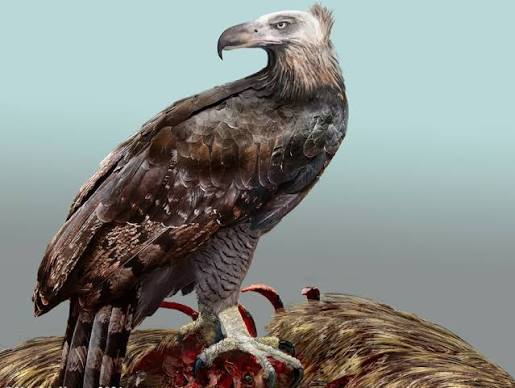
Millions of years ago, early human ancestors faced dangers not only from predators roaming the African grasslands but also from enormous birds of prey watching them from above.
New research and fossil evidence are drawing attention to the role giant eagles may have played in human evolution. Scientists believe that these powerful predators hunted early primates, including young human ancestors, potentially influencing how our distant relatives developed social behaviour, communication and survival strategies.
A recent BBC Future investigation, published on 2 November 2026, explores how the threat of aerial predators may have shaped the evolution of early humans. The investigation features insights from Dr Scott McGraw, a primatologist at Ohio State University, who has studied the relationship between birds of prey and primates.
The terrifying predators that hunted our ancestors
Long before modern humans appeared, enormous predatory birds occupied important positions in prehistoric ecosystems. Some ancient birds developed extraordinary sizes, taking advantage of environments where large prey was available and competition from other predators was limited. Although not all prehistoric giant birds were hunters, certain species became highly effective predators.
For early human ancestors living in Africa, large eagles presented a serious danger, particularly to infants and young children who could be vulnerable when separated from adults. One of the most important pieces of evidence comes from the famous Taung Child fossil discovered in South Africa in 1924.
The fossil belonged to a young Australopithecus africanus, an early human relative believed to have been approximately three to four years old when it died. Researchers later identified damage to the skull consistent with an attack by a large bird of prey, most likely an African crowned eagle.
The Taung Child reveals a disturbing discovery
For decades, scientists debated what had killed the Taung Child. Large land predators were among the suspected explanations. However, research comparing the fossil with the remains of modern primates killed by African crowned eagles revealed important similarities.
Scientists identified damage around the eye sockets that matched marks produced when eagles attack and feed on their prey. Dr McGraw’s research involving more than 600 primates killed by birds of prey in Ivory Coast helped researchers understand these distinctive injuries.
The similarities strengthened the argument that an eagle had attacked and killed the young Australopithecus. The discovery provided important evidence that early human relatives were not simply hunters. They were also vulnerable prey in environments filled with dangerous animals.
How giant eagles may have influenced human evolution
The investigation explores an interesting possibility: the constant threat of attacks from above may have encouraged early human ancestors to develop stronger social connections. Unlike predators that chase animals across open ground, eagles can launch surprise attacks from trees or other elevated positions.
Living in larger groups may therefore have offered protection because more individuals could watch the surrounding environment. Researchers describe this as the many-eyes effect. With several people observing their surroundings, the chances of detecting an approaching predator could increase.
The need to coordinate protection may also have encouraged more sophisticated communication. Archaeologist James Cole suggests that larger groups require individuals to organise responsibilities and share information.
Over time, communication beyond simple gestures and visible signals may have become increasingly important. Scientists are careful not to claim that eagles directly caused human language to develop. Instead, aerial predators may have been one of several environmental pressures influencing social behaviour and communication.
Giant eagles were not limited to Africa
Another example of an enormous prehistoric predator was Haast’s eagle, which lived in New Zealand. With a wingspan approaching three metres and a weight estimated at around 15 kilograms, it was the largest eagle known to have existed. It hunted giant flightless moa birds and possessed powerful talons capable of inflicting devastating injuries.
Māori traditions describe a giant bird known as Te Pouākai or Te Hōkioi, associated with attacks on people. Scientists believe these stories may preserve memories of encounters with Haast’s eagle. The species became extinct following human arrival in New Zealand, environmental changes and the disappearance of its major prey.
What this means for understanding human history
The possibility that giant eagles hunted early human children offers a different perspective on the challenges our ancestors faced. Human evolution was influenced by numerous factors, including climate change, food availability, competition and dangerous predators.
The research highlights how even threats from the skies may have contributed to the development of group living and protective behaviour. Although scientists are still investigating the full extent of these evolutionary pressures, one thing is clear: our ancestors had to survive dangers coming from every direction, including above them.
New attention on aerial predators and human evolution
The BBC Future investigation highlights how giant birds of prey may have influenced early human survival, social behaviour and communication.
2 November 2026 – New investigation explores the history of giant eagles
BBC Future publishes an investigation featuring researchers examining the relationship between prehistoric aerial predators and early human ancestors.
2025 – Research documents a rare attack by a wild harpy eagle
A scientific paper published in Ecology and Evolution documents an attack by a wild harpy eagle on an adult woman in French Guiana, providing further insight into the capabilities of powerful modern birds of prey.
2021 – Scientists investigate the hunting abilities of Haast’s eagle
Research published in Proceedings of the Royal Society B examines the skull and talons of Haast’s eagle, revealing how it could attack enormous prey such as moa.
2006 – Eagle predation linked to the Taung Child
Research comparing the fossil skull with remains of modern primates killed by eagles strengthens the evidence that the young Australopithecus africanus was killed by a bird of prey.