
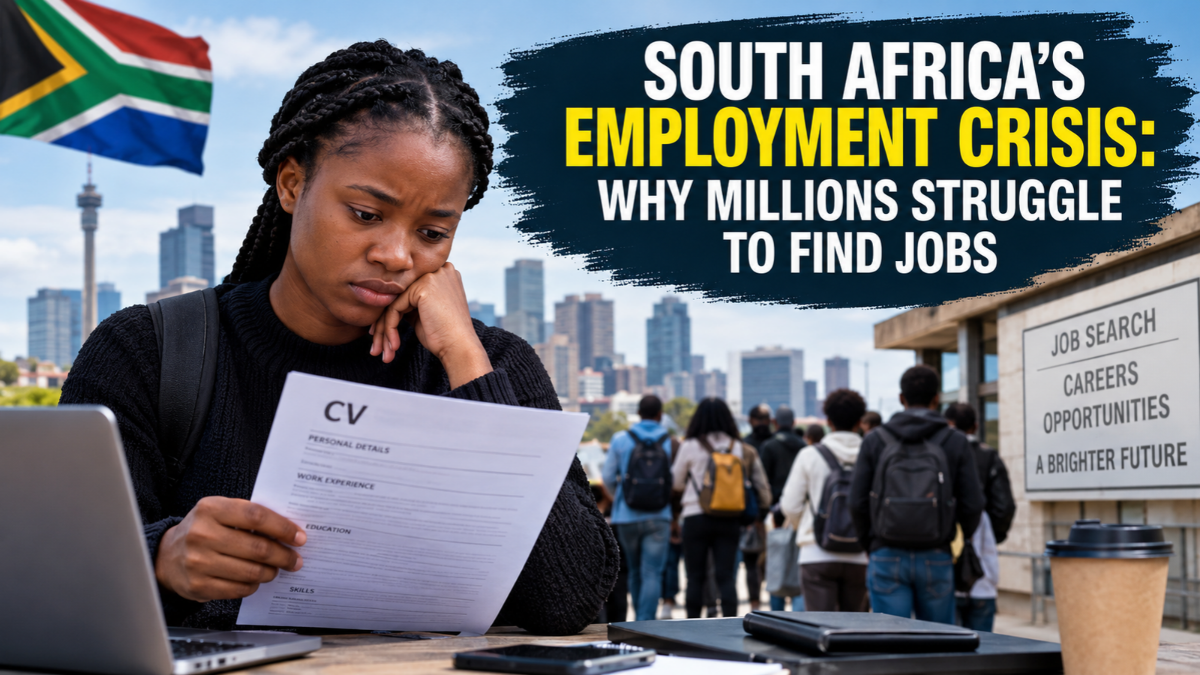
SOUTH AFRICA’S EMPLOYMENT CRISIS: WHY MILLIONS STRUGGLE TO FIND JOBS
Discover why finding a job remains difficult in South Africa, including high unemployment, limited vacancies, skills gaps, transport costs and youth employment challenges.
The latest figures from Statistics South Africa highlight the scale of the problem. In the second quarter of 2026, the official unemployment rate increased to 33.6%, with approximately 8.5 million people unemployed. The number of employed people decreased to 16.7 million compared with the previous quarter. These figures demonstrate the difficulties facing a labour market that struggles to create enough opportunities for everyone seeking work.
For many South Africans, unemployment affects more than their monthly income. It can delay financial independence, increase pressure on families and make it difficult for young people to build careers.
WHY IS FINDING A JOB SO DIFFICULT IN SOUTH AFRICA?
Several economic and structural challenges contribute to the country’s employment crisis. Understanding these factors helps explain why finding work can remain difficult even for people who are actively looking for opportunities.
1. TOO MANY JOB SEEKERS COMPETING FOR LIMITED POSITIONS
One of the biggest challenges is the gap between the number of people looking for work and the number of available vacancies.
Employers may advertise a single position and receive hundreds or even thousands of applications. This is particularly common for entry-level jobs that require little formal experience, including retail assistants, general workers, cleaners, warehouse workers and administrative assistants.
When employers have many applicants to choose from, they can become more selective about qualifications, previous experience, availability and other requirements.
Consequently, applicants who meet the advertised minimum requirements may still struggle to secure interviews.
The problem is not necessarily that job seekers are unwilling to work. In many cases, there simply are not enough suitable vacancies to accommodate everyone.
2. YOUNG PEOPLE STRUGGLE TO GET THEIR FIRST JOB
Young South Africans face particularly difficult conditions when entering the labour market.
Statistics South Africa reported that the unemployment rate among people aged 15 to 24 reached 60.9% in the first quarter of 2026. For those aged 25 to 34, the rate stood at 40.6%.
One reason young people struggle is that many employers prefer candidates who already have practical work experience.
This creates a frustrating situation for school leavers and graduates who need employment to gain experience but cannot easily obtain their first opportunity.
Even advertised entry-level positions sometimes require six months or more of previous experience.
Internships, learnerships, apprenticeships and workplace training can help bridge this gap. However, these opportunities are not always available in sufficient numbers, leaving many young people competing for the same limited positions.
3. EMPLOYERS WANT SKILLS THAT JOB SEEKERS MAY NOT HAVE
Having a qualification does not automatically guarantee employment.
Employers often look for practical abilities that can be applied immediately in the workplace. Depending on the position, these may include computer literacy, customer service, communication, problem-solving, technical knowledge and the ability to work with specific systems.
For example, an administrative position may require knowledge of spreadsheets, email communication and recordkeeping. A warehouse job may require stock-control experience, while a retail position may involve customer service and operating a cash register.
Job seekers who lack these practical skills may find it harder to compete against candidates who have already performed similar duties.
This does not mean that formal education has no value. Rather, qualifications are often most useful when combined with relevant practical skills and experience.
4. SLOW ECONOMIC GROWTH LIMITS JOB CREATION
Businesses are more likely to expand their workforces when they have confidence in future demand, investment opportunities and operating conditions.
When economic growth is weak, some companies may postpone expansion, limit recruitment or focus on controlling costs rather than creating new positions.
South Africa also faces structural challenges involving infrastructure, logistics, investment and the ability of businesses to expand. The International Monetary Fund has identified these constraints as factors that limit the country’s economic growth and capacity to create jobs.
Small businesses are particularly important because they can create employment opportunities across communities. However, businesses that struggle with financing, operating expenses and unreliable infrastructure may find it difficult to grow and employ additional workers.
Improving the conditions in which businesses operate is therefore an important part of addressing unemployment.
5. LOCATION AND TRANSPORT COSTS MAKE WORK LESS ACCESSIBLE
Not every job seeker lives close to major employment centres.
Many vacancies are concentrated in cities, industrial areas, shopping centres and business districts. People living in rural communities or on the outskirts of major cities may need to travel considerable distances to attend interviews or reach potential workplaces.
Transport expenses can become a significant barrier, particularly for unemployed people who have little or no income.
A job seeker may receive an interview invitation but struggle to afford the return journey. Even after securing employment, daily commuting costs can reduce the amount of money available for food, housing and other necessities.
The IMF has highlighted South Africa’s spatial inequality and high transport costs as obstacles to accessing employment opportunities.
Affordable public transport, better connections between residential areas and employment centres, and more opportunities closer to communities could help reduce these barriers.
6. THE APPLICATION PROCESS CAN BE OVERWHELMING
Many job seekers spend hours searching online job boards, visiting company websites and submitting applications.
However, the process can be discouraging when vacancies attract large numbers of applicants or when employers do not communicate the outcome of an application.
Some candidates submit the same CV for every position without adjusting it to match the advertised requirements. Others apply for jobs for which they do not meet the essential qualifications or experience criteria.
Errors such as incorrect contact details, incomplete application forms and missing supporting documents can also reduce an applicant’s chances.
Job seekers can improve their approach by carefully reading each advertisement, tailoring their CV to the position and following the employer’s application instructions.
Nevertheless, even a strong application cannot guarantee success when competition is intense.
HOW UNEMPLOYMENT AFFECTS SOUTH AFRICAN HOUSEHOLDS
Unemployment places financial and emotional pressure on individuals and families.
People without a regular income may struggle to afford groceries, transport, electricity, accommodation and other essential expenses. Families may also need to support unemployed relatives while managing their own household budgets.
For young adults, prolonged unemployment can delay important milestones such as moving out of the family home, saving money or supporting dependants.
Extended periods without work can also make it harder to build professional experience and maintain confidence during the job search.
The effects extend beyond individual households. When fewer people earn wages, spending in local businesses may weaken, placing additional pressure on small enterprises and economic activity.
Addressing unemployment is therefore essential not only for individual well-being but also for broader economic development.
WHAT CAN JOB SEEKERS DO WHILE SEARCHING FOR WORK?
Although job seekers cannot solve the country’s structural employment problems on their own, there are practical steps that may improve their chances of finding work.
Improve your CV: Make sure your CV includes accurate contact details, relevant qualifications, skills and any work experience. Adapt it to the position rather than sending exactly the same version to every employer.
Apply for suitable entry-level positions: Consider opportunities that match your current qualifications and abilities. Where appropriate, explore retail, administration, customer service, hospitality, logistics and general worker positions.
Build practical skills: Short courses, digital skills training, volunteering and relevant community activities can help demonstrate your abilities. Always check whether a course or programme is reputable before paying fees.
Explore workplace training: Learnerships, internships and apprenticeships may offer pathways into industries that require practical experience.
Use reliable recruitment sources: Check employers’ official recruitment channels and carefully verify vacancy details. Never assume that a job advertisement is legitimate simply because it appears online.
Keep track of applications: Record the employer, position, application date and any follow-up instructions. This can help you organise your search and identify opportunities that require further action.
Avoid employment scams: Be cautious of recruiters who demand payment in exchange for guaranteed employment. Verify the organisation and vacancy before sharing sensitive personal information.
For more practical guidance, job seekers can also explore career advice on preparing for interviews, writing a CV and organising an effective job search.
WHAT NEEDS TO CHANGE TO REDUCE UNEMPLOYMENT?
Reducing South Africa’s unemployment rate requires action beyond individual job-search strategies.
Government, businesses, educational institutions and training providers need to work together to expand employment opportunities and improve access to relevant skills.
Encouraging investment, supporting small businesses, improving infrastructure and addressing barriers to business growth can help create conditions in which employers are more willing to recruit.
Expanding workplace training and entry-level opportunities could also help young people gain experience and establish careers.
The Department of Employment and Labour has called for coordinated action between government and the private sector to address the employment crisis, with particular concern about the exclusion of young people from the labour market.
Effective programmes must ultimately lead to meaningful opportunities, rather than simply encouraging people to continue searching in a market where vacancies remain scarce.
CONCLUSION
South Africa’s employment crisis reflects a combination of limited job opportunities, intense competition, skills gaps, slow economic growth and barriers that prevent people from accessing available work.
For young people and inexperienced applicants, securing a first job can be particularly difficult because employers often want candidates who already have workplace experience.
Improving a CV, developing practical skills and applying strategically can help individuals navigate the job market. However, lasting progress will depend on the country’s ability to create more sustainable employment opportunities and make them accessible to a wider range of people.
Until the gap between the number of job seekers and available positions narrows, finding work is likely to remain a difficult challenge for many South Africans.