
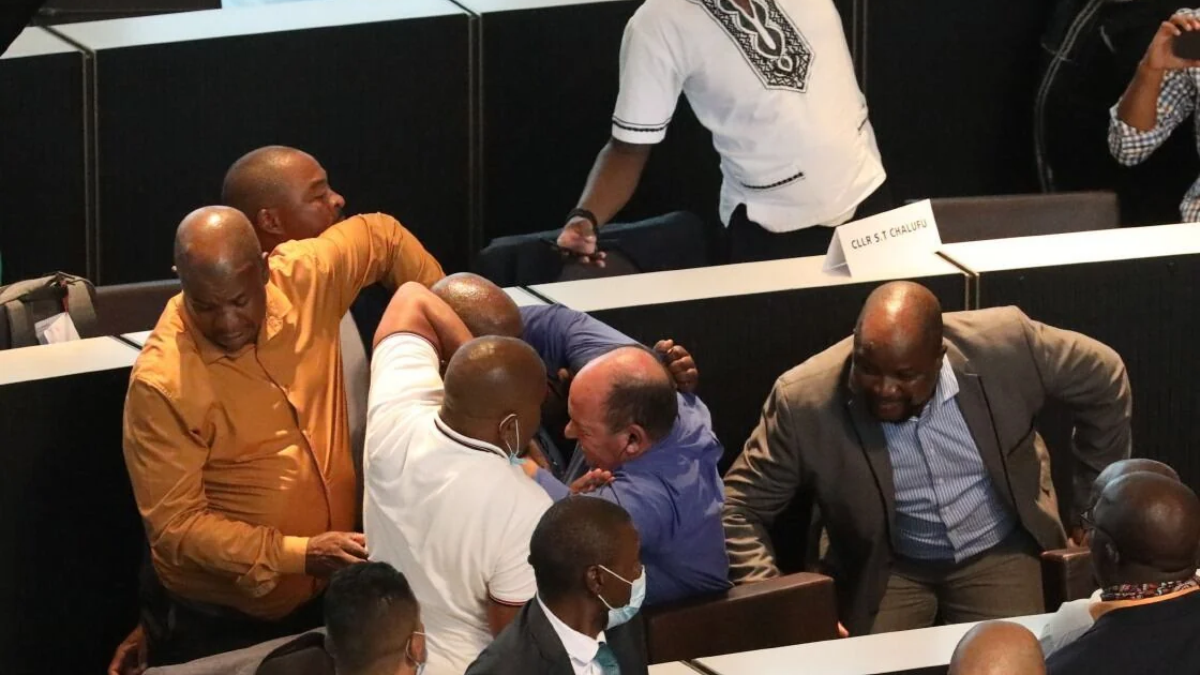
Johannesburg Coalition War Heats Up Ahead of Crucial Local Elections
Johannesburg has become the centre of an increasingly fierce political battle as major parties compete to control South Africa’s economic hub ahead of the local government elections scheduled for November 4, 2026. With another hung council widely anticipated, the fight is no longer simply about winning votes. It is also about finding coalition partners capable of securing a governing majority.
The Democratic Alliance (DA), African National Congress (ANC), Economic Freedom Fighters (EFF), ActionSA and several smaller parties are competing to influence the city’s future. Their disagreements over leadership, governance and service delivery have placed coalition negotiations at the heart of the election campaign. Source: Reuters
Why Johannesburg Has Become a Political Battleground
Johannesburg’s political instability has become a major issue for voters. The city has had seven mayors since 2021, reflecting the difficulties of maintaining stable administrations in a council where no single party has consistently commanded a majority.
The city’s next government will need to address residents’ concerns about water supply, electricity, roads, refuse collection, infrastructure maintenance and financial management. These challenges have made the election particularly significant for residents and businesses that depend on reliable municipal services.
Political analysts have warned that winning the largest share of votes may not be enough to secure the mayoralty. In a fragmented council, parties must negotiate with other political organisations to obtain the support required to govern.
According to Reuters, the Johannesburg contest is part of a wider national test of voter confidence in the ANC and the effectiveness of coalition government ahead of the 2029 national election.
Helen Zille and the DA Target City Hall
The DA, led by Helen Zille’s Johannesburg campaign, is seeking to strengthen its position and potentially secure an outright majority. The party has focused on infrastructure, financial accountability and improving municipal service delivery.
Zille has ruled out coalition agreements with the EFF and uMkhonto weSizwe (MK) Party, while leaving the door open to negotiations with other parties after the election. This approach could limit some coalition options if the DA falls short of a majority.
The challenge is significant: even a strong electoral performance may leave the DA dependent on smaller parties to form an administration.
The party must therefore convince voters that its plans for Johannesburg can translate into practical improvements while demonstrating that it can build a workable governing arrangement.
ANC Faces a Difficult Coalition Decision
The ANC is also under pressure to retain political influence in Johannesburg. Although the party has governed the city for extended periods, its electoral support has weakened, and its future role may depend on negotiations with parties that have previously opposed it.
One potential scenario involves cooperation between the ANC and the DA, a development that could reshape local politics. However, such an agreement would require both parties to overcome significant ideological and political differences.
An ANC-DA coalition could also have implications beyond Johannesburg, particularly for relations between the parties in South Africa’s national government.
Political analyst Richard Calland has noted that the ANC could find it difficult to accept a junior role in a local coalition led by the DA. The possibility remains uncertain, however, and would depend on election results and decisions by the parties’ leadership. Source: Business Day
EFF and Smaller Parties Could Hold the Balance
The EFF, ActionSA, MK Party, Patriotic Alliance and other smaller parties could become influential if the larger parties fail to secure enough seats to govern independently.
Their support may determine who becomes mayor and which parties receive positions in the mayoral committee. However, disagreements over policy, political leadership and allegations of governance failures could complicate negotiations.
During a recent Johannesburg leadership debate, DA leader Geordin Hill-Lewis and EFF leader Julius Malema clashed over the EFF’s record in coalition governments, with each presenting sharply different accounts of the party’s role in municipal governance. Source: IOL
These disputes illustrate the challenge facing parties that may need to cooperate after campaigning against one another.
Service Delivery Must Remain the Priority
For Johannesburg residents, the political contest will ultimately be judged by whether the next administration can improve everyday life.
Reliable water and electricity, better roads, effective waste collection, transparent spending and stronger municipal finances are among the issues that require urgent attention. Political agreements that focus only on executive positions risk deepening public frustration if they fail to deliver measurable improvements.
The next council will need a clear governing programme, realistic budgets and mechanisms that allow residents to hold leaders accountable.
Conclusion: Who Will Win the Joburg Coalition War?
Johannesburg’s coalition battle is entering a decisive phase as parties prepare for the November 4 vote. The DA is pursuing stronger control, the ANC is fighting to preserve its influence, and smaller parties are positioning themselves to shape the outcome.
Ultimately, the winner may not be the party that finishes first at the ballot box, but the group of parties capable of negotiating a stable and effective government.
For residents, the most important outcome will be whether the next coalition can move beyond political rivalry and deliver the reliable services, sound financial management and accountable leadership that Johannesburg urgently needs.